Course Offerings - Languages
Course Offerings - Languages
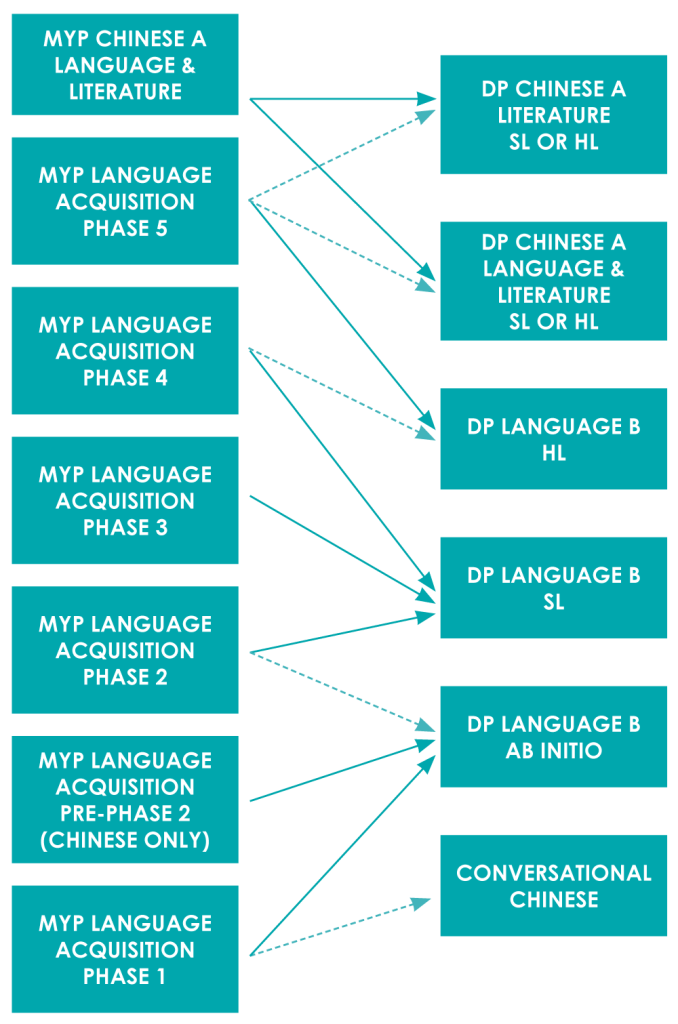
High School Languages Program Chart
Students who are native speakers of French and Spanish are recommended to take Self-taught School-Supported Language A: Literature.
Language Acquisition (Chinese, French, Spanish)
IB MYP Language Acquisition (Chinese, French, Spanish)
IB MYP Language & Literature (Chinese)
IB DP Group 1
• Chinese A: Literature
• Chinese A: Language and Literature
• Self-taught School Supported
• Language A: Literature
IB DP Group 2
• French B; French Ab Initio
• Spanish B; Spanish Ab Initio
• Chinese B; Chinese Ab Initio
HS Course
• HS Conversational Chinese
Grade 9 & 10 Language Acquisition (IB MYP)
IB MYP Language Acquisition is for students whose primary language is not the target language. The main aim of language acquisition in the MYP is to encourage students to gain competence in a modern language (Chinese/French/Spanish) other than their primary language.
The study of MYP language acquisition aims to encourage in the student a respect for and understanding of other languages and cultures and to provide a skills base to facilitate further language learning.
The Language Acquisition subject group will be organized from Phase 1 to Phase 5. The phases represent a developmental continuum of additional language learning. Students may commence their Language B course at any phase on the continuum.
Content
Units are planned to ensure ample opportunities to practice and develop the skills of language: listening, speaking, reading, writing, and viewing and interpreting.
Assessment
To measure the progress and achievement of a student in each phase of the course, four criteria have been established:
A: Listening B: Reading
C: Speaking D: Writing
Chinese is also offered as mother tongue (Language A).
It is a joint effort of the teachers, parents, and students to make sure that students choose their foreign language courses appropriately. Teachers’ recommendations and students’ assessment results are key elements in the course selection process for languages.
Students who have studied: Chinese for no more than 3 years; French and Spanish for no more than 2 years; from Grade 6 to Grade 10 before starting Grade 11 are eligible to take DP Language Ab initio.
Additionally, if a student graduates from Grade 10 Languages class at Phase 2 or higher, it is recommended that they proceed to DP Language SL or HL.
Native and near-native speakers:
A student would be considered a native speaker, and therefore not eligible to enroll in a language acquisition course for that language if they meet any of the following criteria:
1) The student’s registered home language(s) includes the language for which they are applying;
2) The student has been assessed as a native speaker through the language placement test for that language;
3) The student has studied the language as a Language A course during their secondary education.
A student who needs support in only one language skill does not qualify for a language acquisition course.
Note:
Due to the unique nature of character-based writing systems, Chinese students who are native speakers in listening and speaking but have no knowledge of characters may be eligible for placement in Chinese BSL at a minimum level.
High School Chinese Courses
Conversational Chinese
WAB conversational Chinese is a two-year course designed for Grade 11 and 12 students who are only focusing on practical day-to-day conversation. The aim of this course is to provide students with an opportunity to learn speaking and listening skills and to learn about Chinese culture within the context of China. By the end of this course, students should be able to conduct a relatively intensive conversation in Chinese and have a thorough and clear understanding of Chinese culture.
Course Content
The topics covered include personal attributes, personal relationship, eating and drinking, daily routine, leisure activities, education, and transportation, etc. Cultural activities will be an important part of the course. The course is assessed according to the criteria described below. The course uses a variety of text types in relation to the prescribed themes and topics which include visual texts, audio texts, and also audio-visual texts.
Course Criteria
1. Understand and use language appropriate to a range of interpersonal and/or intercultural contexts and audiences.
2. Understand and use language to express and respond to a range of ideas with fluency and accuracy.
3. Identify, organize and present ideas on a range of topics
Assessment
Listening test (40%), Speaking test (40%), project and homework (20%).
IB DP Chinese A: Language and Literature (HL & SL)
In the Chinese A Language and Literature course, students study a wide range of literary and non-literary texts in a variety of media. By examining communicative acts across literary form and textual type alongside appropriate secondary readings, students will investigate the nature of language itself and the ways in which it shapes and is influenced by identity and culture. Approaches to study in the course are meant to be wide-ranging and can include literary theory, sociolinguistics, media studies, and critical discourse analysis, among others.
The aims of all subjects in studies in language and literature are to enable students to:
- Engage with a range of texts, in a variety of media and forms, from different periods, styles, and cultures
- Develop skills in listening, speaking, reading, writing, viewing, presenting and performing
- Develop skills in interpretation, analysis and evaluation
- Develop sensitivity to the formal and aesthetic qualities of texts and an appreciation of how they contribute to diverse responses and open up multiple meanings
- Develop an understanding of relationships between texts and a variety of perspectives, cultural contexts, and local and global issues and an appreciation of how they contribute to diverse responses and open up multiple meanings
- Develop an understanding of the relationships between studies in language and literature and other disciplines
- Communicate and collaborate in a confident and creative way
- Foster a lifelong interest in and enjoyment of language and literature.
At WAB, Chinese A Language and Literature is targeted ideally for students who have:
Finished MYP Chinese A course
orAchieved excellent levels of achievement in the MYP Chinese Language Acquisition Phase 5
Content
The course is consists of 3 Areas of Exploration:
Readers, writers, and texts
Time and space
Intertextuality: connecting texts
The Learner Portfolio is a central element of the course and is mandatory for all students. It is an individual collection of student work compiled during the two years of the course.s
Assessment
External assessment
Paper 1: Guided literary analysis – 35% (SL & HL)
Paper 2: Comparative essay – 35% (SL) / 25% (HL) Essay (HL) – 20%
Internal assessment
Individual oral – 30% (SL) / 20% (HL)
IB DP Chinese A: Literature (HL & SL)
In the Chinese A Literature course, students will focus exclusively on literary texts, adopting a variety of approaches to textual criticism. Students explore the nature of literature, the aesthetic function of literary language and textuality, and the relationship between literature and the world.
The aims of all subjects in studies in language and literature are to enable students to:
- Engage with a range of texts, in a variety of media and forms, from different periods, styles, and cultures
- Develop skills in listening, speaking, reading, writing, viewing, presenting and performing
- Develop skills in interpretation, analysis and evaluation
- Develop sensitivity to the formal and aesthetic qualities of texts and an appreciation of how they contribute to diverse responses and open up multiple meanings
- Develop an understanding of relationships between texts and a variety of perspectives, cultural contexts, and local and global issues, and an appreciation of how they contribute to diverse responses and open up multiple meanings
- Develop an understanding of the relationships between studies in language and literature and other disciplines
- Communicate and collaborate in a confident and creative way
- Foster a lifelong interest in and enjoyment of language and literature.
At WAB, Chinese A Literature is targeted ideally for students who have:
• Finished MYP Chinese A course
or
• Achieved consistently high levels in the MYP Phase 5 Chinese Language Acquisition course
Content
The course consists of 3 Areas of Exploration:
• Readers, writers, and texts
• Time and space
• Intertextuality: connecting tests
The Learner Portfolio is a central element of the course and is mandatory for all students. It is an individual collection of student work compiled during the two years of the course.
Assessment
External assessment
Paper 1: Guided literary analysis – 35%
Paper 2: Comparative essay – 35% (SL) / 25% (HL)
Essay (HL) – 20%
Internal assessment
Individual oral – 30% (SL) / 20% (HL)
IB DP Self-Taught School Supported Language A: Literature (SL Only)
The IB DP Self‑Taught School‑Supported Language A: Literature course is intended for native, near‑native, or bilingual‑level students. These learners will study either their home language or another language in which they already have advanced linguistic competence. The self-taught nature of the course requires students to be highly motivated and independent learners. However, they will receive support from a designated tutor, who will guide them through the course requirements and provide feedback on their progress as well as the school SSST coordinator.
Additionally, students may collaborate with other students and parents to enhance their learning experience.
By the end of the course, students will:
- Develop a deep understanding and appreciation of literature in their chosen language.
- Enhance their analytical and critical thinking skills. Improve their ability to express ideas clearly and effectively in both written and oral forms.
- Gain insights into the cultural, historical, and social contexts of literary works. Foster a lifelong love for reading and literature.
Content
This course allows students to explore a wide range of literary works from their chosen language, fostering a deep appreciation for literature and enhancing their analytical and critical thinking skills.
The course consists of 3 Areas of Exploration:
- Readers, writers, and texts.
- Time and space.
- Intertextuality: connecting texts.
The Learner Portfolio is a central element of the course and is mandatory for all students. It is an individual collection of student work compiled during the two years of the course. It can be a journal, electronic or handwritten, notebook, folder, blog or any other format that suits learning style and shows the learning journey.
Assessment
Paper 1: Guided literary analysis – 35%
Paper 2: Comparative essay – 35%
Individual oral – 30%
IB DP Language Ab Initio
Language Ab Initio is a language acquisition course for students with little or no experience of learning Chinese. This course is designed to be studied over two years by students in Grades 11 and 12.
Content
A key aim of the language ab initio course is to develop international mindedness through the study of language, culture, ideas, and issues of global significance. Explicit links to TOK strengthen the ability to communicate in the target language by increasing students’ self-awareness as inquirers in their own language learning process. As appropriate to the level of the course, communication skills are reinforced through the other categories of approaches to learning skills: thinking, research, social, and self-management skills.
Five prescribed themes are common to the syllabuses of language B and language ab initio; the themes provide relevant contexts for study at all levels of language acquisition in the DP, and opportunities for students to communicate about matters of personal, local or national, and global interest.
The five prescribed themes are:
identities
experiences
human ingenuity
social organization
sharing the planet.
Assessment
External examination
Paper 1: writing – 25%
Paper 2: listening and reading – 50%
Internal Assessment
Individual oral assessment – 25%
IB DP Language B SL
IB DP Language B SL is for students who have studied at least two years of the language. The main focus of the course is language acquisition. These language skills should be developed through the study and use of a range of written and spoken materials.
Content
A key aim of the Language B course is to develop international-mindedness through the study of language, culture, ideas, and issues of global significance. Explicit links to TOK strengthen the ability to communicate in the target language by increasing students’ self-awareness as inquirers in their own language learning process. As appropriate to the level of the course, communication skills are reinforced through the other categories of approaches to learning skills: thinking, research, social, and self-management skills.
Five prescribed themes are common to the syllabuses of language B and language ab initio; the themes provide relevant contexts for study at all levels of language acquisition in the DP and opportunities for students to communicate about matters of personal, local or national, and global interest.
The five prescribed themes are:
identities
experiences
human ingenuity
social organization
sharing the planet.
Assessment
External assessment
Paper 1: writing – 25%
Paper 2: listening and reading – 50%
Internal assessment
Individual oral assessment – 25%
IB DP Language B HL
The IB DP Language B HL courses are similar to IB DP Language B SL but will differ in in the level of competency the student is expected to develop in the receptive, productive and interactive skills. In addition, the study of two literary works originally written in the target language is required for language B HL.
Assessment
External assessment
Paper 1: writing – 25%
Paper 2: listening and reading – 50%
Internal assessment
Individual oral assessment – 25%